

Effective Practices: Engaging Employees to Master AI in Their Jobs
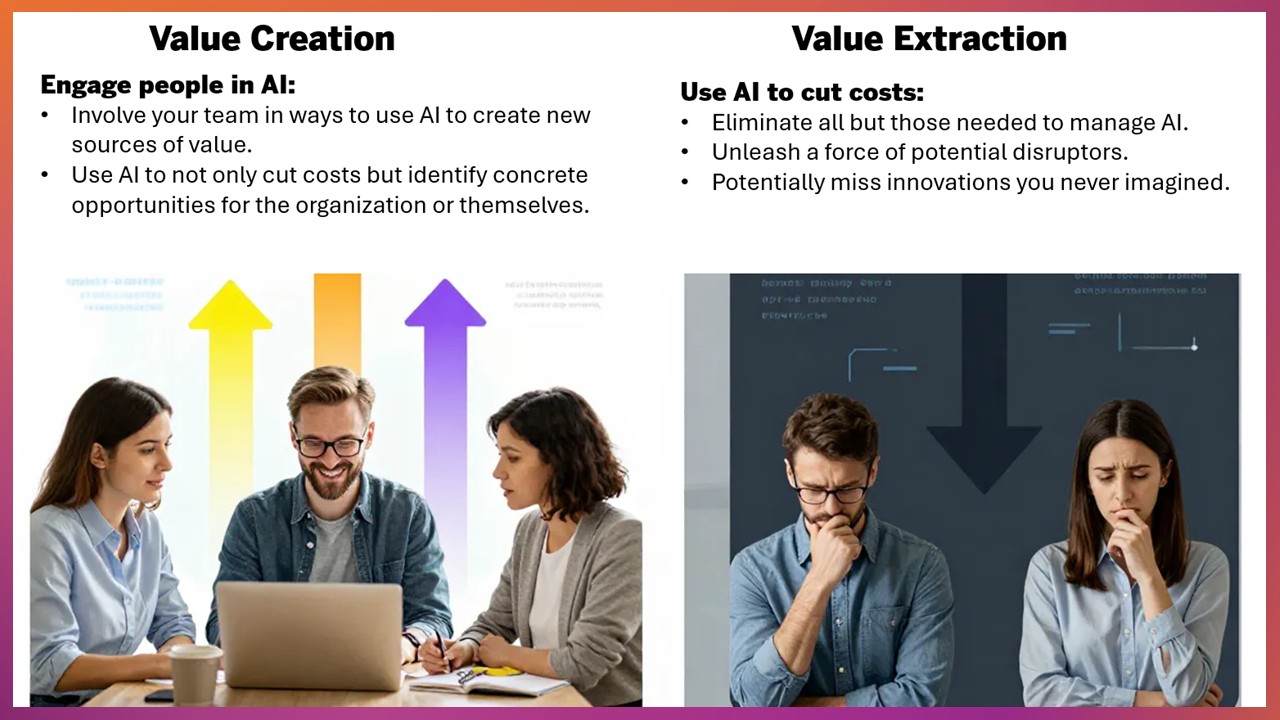
.jpeg) Here’s a plan based on the principles of Total Quality Management (TQM) for people to engage your stakeholders in ways to use AI to fulfill the purpose, goals, objectives, and values of your organization or their own teams.
Here’s a plan based on the principles of Total Quality Management (TQM) for people to engage your stakeholders in ways to use AI to fulfill the purpose, goals, objectives, and values of your organization or their own teams.By Bruce Bolger
Step 1. Purpose and Reward Structure
Step 2. Cross-Functional Planning
Step 3. Program Launch
Step 4. Drip Training, Nudges, and Ongoing Communication
Step 5. Idea Submission and Evaluation
Step 6. Recognition and Updates
Step. 7. Measurement and Reporting
Click here to subscribe to RRN weekly, and here for an RRN media kit.
As artificial intelligence tools become increasingly accessible, organizations are looking for practical ways to help employees understand how these technologies can support their day-to-day work. Based on TQM principles applied to people management, here’s a structured, six-month approach combining purpose, communication, training, governance, rewards and recognition, and measurement to encourage employees to explore and propose AI-related improvements in the workplace.
Step 1. Purpose and Reward Structure 
The objective is to motivate employees to learn enough about approved AI tools to test their potential applications to their own or related jobs. If AI can automate some aspects of their jobs, what additional value could they add with the freed up time? Under this framework, all employees are encouraged to submit:
· Valid ideas for applications for their jobs and others, for which they earn points based on the value determined.
· Ideas of merit—those with measurable organizational value—these can earn higher point levels based on criteria such as scalability, time or cost savings, or enhanced service quality.
Although recipients can redeem the points for potentially high value rewards, they are offered as points to avoid confusion with compensation, given that the award likely will not occur in the following year.
The structure is designed to reinforce continuous improvement rather than one-time participation.
Step 2. Cross-Functional Planning
· A steering group representing all key stakeholder categories is formed at the outset. This group defines the program’s purpose, goals, values, and evaluation criteria. While certain roles may have more immediate use cases for AI, the recommendation is to make participation open to all employees to ensure inclusion and broad-based innovation.
· A technical team from each stakeholder group and IT along with other key stakeholder group leaders is responsible for selecting the most appropriate AI tool or tools to pilot and for developing initial guidance and example applications.
Step 3. Program Launch
· The CEO kicks off the campaign in a live and recorded video meeting encapsulated in the organization’s communications platforms.
· The initiative begins with a live and recorded briefing for employees outlining the purpose and expectations of the program, safe AI usage practices, and the learning and communication resources that will be provided throughout the six-month effort.
Step 4. Drip Training, Nudges, and Ongoing Communication
The communications and learning teams provide employees with practical information on how to test AI tools within safe-use guidelines. Support includes:
· Short training modules and quizzes for which they can earn points for successful completion
· Basic prompt examples
· Role-specific use-case suggestions
· Periodic “nudges” to reinforce engagement
These nudges may include short knowledge checks, reminders of training availability, sample prompts, and pulse surveys to monitor confidence and satisfaction.
Employees get points for successfully participating in training, even if they do not submit an idea.
Step 5. Idea Submission and Evaluation
Employees submit ideas through a simple form describing the proposed AI application, expected benefit, and any considerations. A joint evaluation team made up of AI specialists and stakeholder representatives reviews each submission through the platform and grades the submission for practicality and potential value in terms of productivity or quality achieved or new value to the external or internal customer. Based on the standard for acceptance, and its combined ranking by the committee, the recipient receives points for redemption in a rewards catalog and recognition and expressions of appreciation in the communications platform and in team meetings.
Step 6. Recognition and Updates
Throughout the program, the organization communicates approved ideas, the contributors, and the recognition they received. Sharing these updates promotes transparency and encourages continued participation. If appropriate, they are added to the company’s knowledge library.
Step. 7. Measurement and Reporting
At the end of the six-month period, the organization measures results using metrics such as:
· Estimated value of approved ideas
· Number of submissions and percentage approved
· Participation rates
· Pulse survey results
· AI literacy quiz outcomes
The findings can be used to determine whether to extend, revise, or institutionalize the program as part of a continuous improvement process.
Enterprise Engagement Alliance Services
Celebrating our 15th year, the Enterprise Engagement Alliance helps organizations enhance performance through:
1. Information and marketing opportunities on stakeholder management and total rewards:
ESM Weekly on stakeholder management since 2009; click here for a media kit.
RRN Weekly on total rewards since 1996; click here for a EEA YouTube channel on enterprise engagement, human capital, and total rewards insights and how-to information since 2020.
2. Learning: Purpose Leadership and Stakeholder
 Management Academy to enhance future equity value and performance for your organization.
3. Books on implementation: Enterprise Engagement for CEOs and Enterprise Engagement: The Roadmap.
4. Advisory services and research: Strategic guidance, learning and certification on stakeholder management, measurement, metrics, and corporate sustainability reporting.
5. Permission-based targeted business development to identify and build relationships with the people most likely to buy.
6. Public speaking and meeting facilitation on stakeholder management. The world’s leading speakers on all aspects of stakeholder management across the enterprise.